
Textile framing · rugs · scarves · woven work
Textile framing starts with support.
A scarf, woven piece or heavy rug needs to be supported without stretching, flattening or distorting it. The mounting method depends on the textile itself.
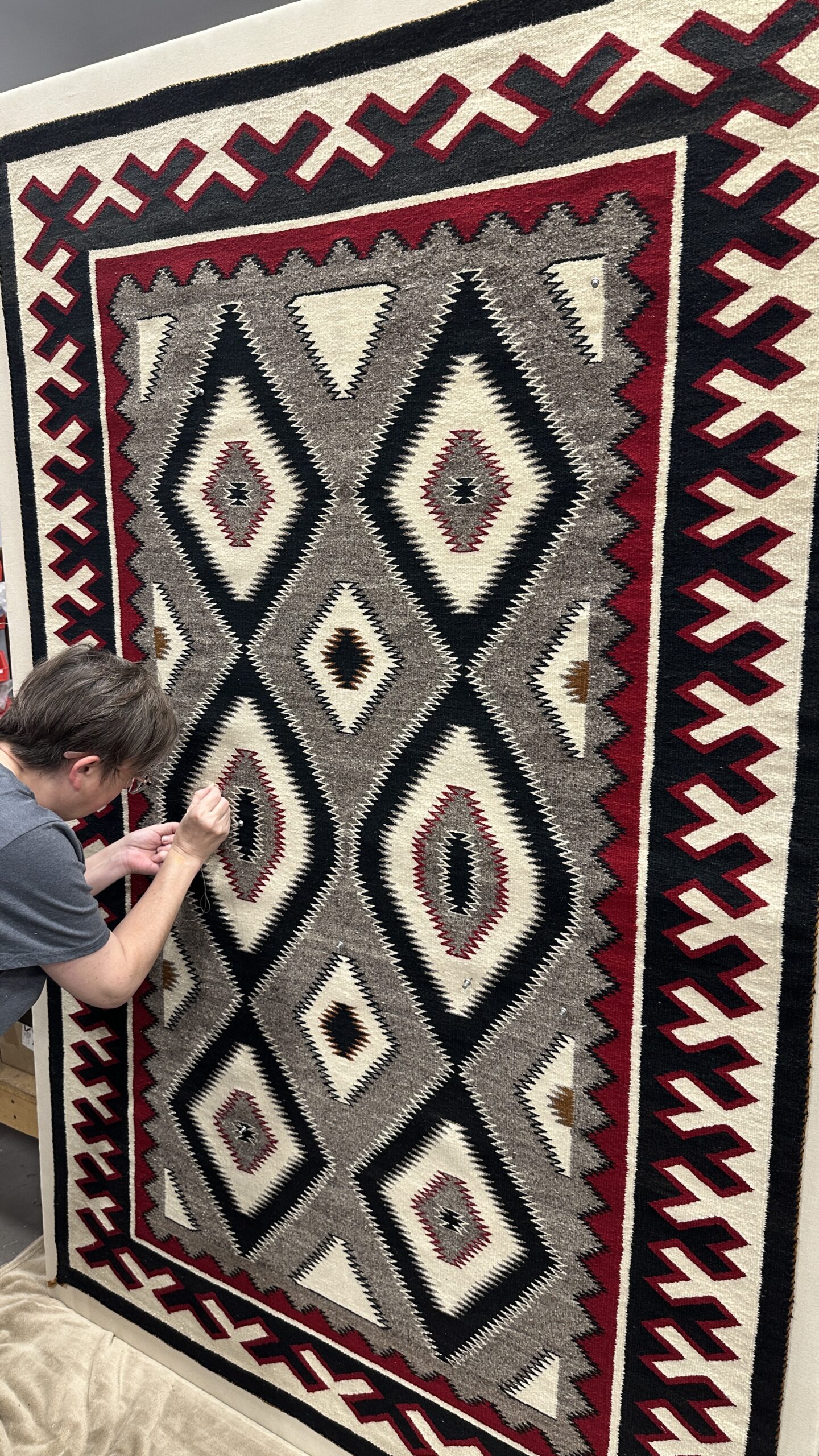
Start with the weight
The first question is how the textile’s weight will be supported.
A silk scarf and a heavy woven rug need very different support.
Many flat textiles use a rigid, fabric-covered support with discreet stitching. Larger or heavier pieces need support spread across more of the width.
The support is both structural and visual.
The fabric-covered support can also provide the visual field around the textile.
Mounting methods
The mounting method depends on the textile.
Weight, condition, weave and the amount of visible edge determine the mount.
Hand stitching across a support
Small stitches can secure a sound textile to a fabric-covered support without pulling the weave out of shape.
Padded support where needed
A thin padded layer can soften contact with a rigid support.
Fabric-covered support
Prewashed display fabric provides the support surface and can also become part of the design.
Broad support for rugs and tapestries
A strong rug or tapestry may use a broad sewn support so the load is shared across the width.
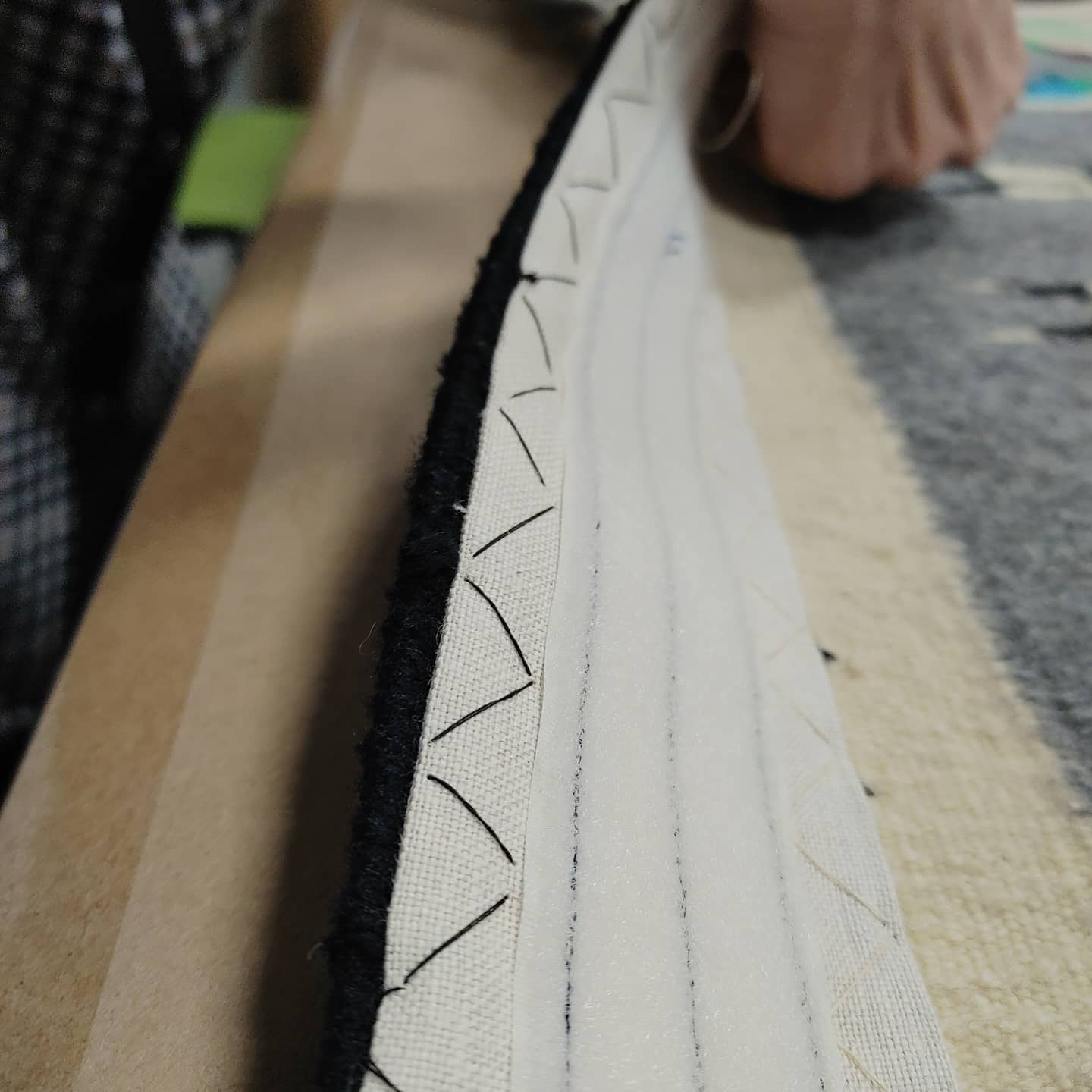
Stitches should support the textile without distorting the weave.
The mount should support the textile without changing its natural shape or character.
Rugs and heavier woven work
Heavy rugs need broad, even support.
Heavy textiles need support that shares the load across a wide area.
Why not staples or tacks?
Tacks and staples concentrate force and can damage fibers. Sewn supports spread the load.
When is a full rigid backing useful?
A padded, fabric-covered board can support a rug across most of its area, with stitching distributed as needed.
Can a large rug hang without a full board?
Some strong textiles can use a broad sewn strip or sleeve; condition and display method determine whether that is appropriate.
What if the rug is fragile?
If a textile is weak, brittle, torn or badly distorted, treatment may come before framing.
Scarves, silks and fine fabrics
Fine fabrics need support without being flattened or pulled out of shape.
The hem, weave and handmade edges are part of the object. We support them without forcing the piece perfectly square.
Decide how much edge to show
A support can sit inside the hem, under the edge or leave a visible field around the textile. That choice changes how the finished piece looks.
Do not force handmade edges straight
Printed scarves can vary slightly in shape; we align them visually without overstressing the fabric.
Choose the background around the textile
The background fabric may be neutral or chosen to work with the pattern.
Keep the textile off the glazing
A deep spacer or shadowbox keeps glazing away from the textile and leaves room for surface relief.
Glazing and spacing
Glazing can protect a textile, but it should not touch the fabric.
A spacer or deep frame keeps glazing away from texture, knots and folds.
Glass is rigid and scratch resistant. Acrylic is lighter and less breakable; anti-static acrylic is available when loose fibers or static are a concern.
Protection depends on support, spacing, glazing and display.
Glazing, support, backing and display location all matter. UV filtering is only one part of protecting a textile.
Before framing
Check condition before mounting.
If a textile is dirty, brittle, torn or badly distorted, conservation may need to come first.
Cleaning
Framing is not a substitute for cleaning or conservation treatment.
Old mounts
Old adhesive, staples, acidic boards and tight stretching can leave damage. We separate what we can safely handle from work that belongs with a textile conservator.
Specialist conservation
When treatment is needed, we bring in a textile conservation specialist before building the new mount.
Textile reference
Textile Conservation Reference
Support, stitching, display and condition guidance for framed textiles, rugs, scarves and needlework.
A textile should be supported across an area, not hung from a few stressed points.
For many flat textiles, a fabric-covered rigid support provides the most controlled presentation. The support carries the textile while stitching keeps it in position. The goal is to distribute weight without pulling the weave out of shape.
Support fabrics
Backing fabrics should be clean, stable and colorfast. In conservation practice they are commonly washed before use to remove sizing and residues. The support fabric and padding are selected so they do not imprint an unwanted texture through the textile.
Stitching
- Use as few stitches as the support requires.
- Place stitches through existing openings or between threads where practical rather than cutting fibers.
- Keep tension relaxed; tight stitching can pucker the textile and break aged fibers.
- Add internal support stitches when the weight of the textile would otherwise sag between the perimeter attachments.
- Use thread compatible with the textile and discreet enough not to become part of the visual design.
Heavy textiles need a different support strategy from a small sampler.
Gravity is the main problem. A large rug or tapestry can tear itself slowly if too much weight is carried by a narrow top edge or a small number of stitches. The mount should spread the load across a broad area.
Design considerations
- Overall weight and the strength of the original weave.
- Whether the object can safely be framed or should use a different museum-style hanging support.
- Rigid support and frame depth required to keep the textile planar without crushing it.
- How the mount can be inspected and removed later.
- Whether weak areas, insect damage or previous repairs need conservation treatment before display.
Do not force a textile flat.
A historic textile may have permanent distortions, stretched areas or dimensional surface. Flattening those features under pressure can create new damage. The mount should support the object as it exists.
Lightweight textiles can still require complex support.
Silks and fine decorative fabrics can be extremely light sensitive and may have weak seams, fugitive dyes, metallic threads or finishes that respond poorly to moisture. A mount has to support them without creating a visible grid of tension.
What we look for
- Weak folds, creases and areas of previous stress.
- Color change or fading that suggests high light sensitivity.
- Dyes that may be unstable or have migrated previously.
- Embroidery, beads or metallic threads that add localized weight.
- Existing hems and construction details that can be used for support without altering the object.
Scarf presentation
A scarf can be shown square, on point, folded or with dimensional drape, but the mount should not depend on stretching the fabric tight. The visual design and the support system have to be developed together.
Glazing keeps dust and hands away, but the textile still needs clearance.
Glass or acrylic can protect a textile from dust, pollutants and accidental soiling. The glazing should not press on fibers, embroidery, beads or fringe. A spacer or deep frame creates the necessary air gap.
Glass versus acrylic
Glass is harder to scratch and has low static. Acrylic is much lighter and safer at large sizes but can attract loose fibers when it develops static. The size of the frame and the sensitivity of the surface guide the choice.
Light exposure
Dyes and fibers can be highly light sensitive. UV filtering is useful, but visible light still fades color and weakens fibers. Sensitive textiles should be kept out of direct sun and, for important pieces, displayed at lower light levels or for limited periods.
Heat and airflow
Avoid mounting framed textiles directly over heat sources or in strong HVAC discharge. Localized heat and rapid humidity changes can accelerate deterioration and dimensional change.
Condition comes before mounting.
Some textiles should not be framed until they have been examined by a textile conservator. A beautiful new enclosure does not stabilize weak fibers, active mold or insect damage.
Refer before framing when we see
- Active mold or insect activity.
- Powdering, brittle or splitting fibers.
- Tears, losses or seams that cannot support the intended mount.
- Adhesive residues or textiles glued to acidic board.
- Unstable stains or dyes that may be fugitive.
- Complex historic mounting that may itself be significant.
Documentation matters.
For important textiles, we record the condition we can see before mounting and make the support removable. The best mount should be quiet visually and understandable to the next person who has to care for the object.
Have a textile you want us to look at?
Bring it to Old Town if it is easy to transport. For very large rugs or fragile textiles, call first.